Irving Penn by Horst, 1951
American photographer Irving Penn, (1917-2009) made art for over 70 years. In October, The Smithsonian Museum in Washington, D.C., celebrates his work with Irving Penn: Beyond Beauty, at the American Art Museum (8th and F Streets, N.W.,1st floor West) until March 2016.
from Vogue cover, 1950
Irving Penn transformed fashion photography with his work for Vogue in the '40s and '50s. He then began to both capture and create many of the icons of the 20th century: it's difficult to think of Picasso, Pacino, Capote, Dietrich, without one of his luminous portraits springing to mind.
Pablo Picasso, Cannes 1957
He was in complete control in the studio, ushering his subjects into a corner he'd made by slanting two backdrops together. Deprived of props and PR, hunched into a small grey space, the great personalities of the day revealed themselves in surprising ways to the camera. Limiting his subjects' movement relieved him, Penn said, "of part of the problem of holding on to them.”
Truman Capote, New York 1965
His compositions were always simple; even his fashion shoots were famously unfussy. He didn't speak much to his subjects as he worked, unless it was to ask something that might jolt them into being themselves. Penn was never happier than when he left the bright, tight glitz of the cities and went to parts and people unknown. Places like Peru, Dahomey (now Benin), Morocco, and New Guinea.
Tambul Ialibu Warrior, New Guinea, 1970
In 1948, after a shoot for Vogue in Lima, he travelled to Cuzco, historic capital of the Inca Empire. Intrigued with the look of the local people, he decided to try to take some portraits. He then happened on the only photo studio in the town. Thrilled with its stone floor and perfect northern light, he convinced the owner to take some time off and let him rent it.
In the most affecting shot from those few days, Penn placed a boy and a girl in the room on each side of a wooden stool. The children are so tiny that the stool appears to be table-high. Diminutive figures with immense self-possession, they hold hands and stare out at Penn, at the unknown world that lives in that box and beyond it, with an innocence and dignity that could break your heart.
Cuzco Children, Peru 1948
In the 1960s, he became smitten with platinum rather than silver printing, although the process demanded much more time and precision in the darkroom. It was worth it for the velvety blacks and glowing whites of the resulting image, nowhere more evident than in his series from Dahomey, where the dark skin of his subjects made for some of his most striking work.
Scarred Dahomey Girl
In 1972, Penn went to the southwest desert area of Morocco to photograph the blue men of the Tuareg. However, they had no interest in his enterprise. He had more luck with the Guedra women in Guelmine, who “sat, eyes fixed on the lens, enjoying the camera’s scrutiny yet themselves impenetrable…"
In Worlds in a Room, published in 1974, Penn wrote about his journeys in prose as elegant as his photographs. In Morocco, although having met the first photographic subjects he couldn't control, he seems not to regret it at all: "What is revealed is no more than these mysterious creatures meant us to know."
Guedras in the Wind, Morocco 1971
Resurrection and Wright
Lady Holding a Hat © Willie Anne Wright
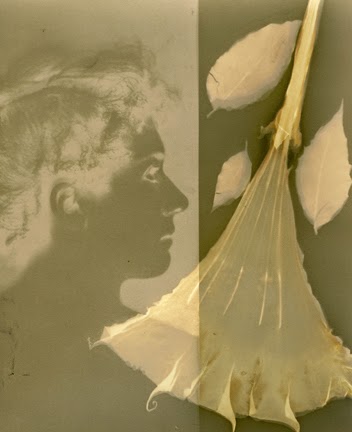
Brugmansia blossoms face the ground rather than the sky, a commotion of silent bells. Shamans in South America use them to speak with the dead. In her own way, fine art photographer, Willie Anne Wright, does, too. Like any good conjuror, she's always open to new talismans. A few years ago, a friend gave her a potted Brugmansia.
In the series spawned by the flower, she went back to the beginnings of photography and created photograms. Placing cut blossoms and the images she wants to call home in full sun, she waits. The silent brugs trumpet. And soon enough, the phantoms come.Profile of a Lady © Willie Anne Wright
Brugmansia blossoms face the ground rather than the sky, a commotion of silent bells. Shamans in South America use them to speak with the dead. In her own way, fine art photographer, Willie Anne Wright, does, too. Like any good conjuror, she's always open to new talismans. A few years ago, a friend gave her a potted Brugmansia.
In the series spawned by the flower, she went back to the beginnings of photography and created photograms. Placing cut blossoms and the images she wants to call home in full sun, she waits. The silent brugs trumpet. And soon enough, the phantoms come.Profile of a Lady © Willie Anne Wright
Bird Men
Vorbild Nature: Da Vinci's Designs at the Deutsches Museum
Five hundred years ago, Leonardo watched bats and birds to find inspiration for creating a flying machine. His detailed drawings come to life in the current show at Munich's Deutsches Museum. Leonardo never did fly, but his drawings are testament to his talent and passion. German engineer, Otto Lillienthal, was also a birdman. Dubbed the "Glider King," Lillienthal built a platform on a hill near Berlin in 1894 so that he could launch his bird-inspired crafts himself. With wings he made of linen-covered bamboo, Lillienthal took flight over 2000 times before he fell to his death at the age of 48. Too young, but what a way to go. Most of us never even get to the drawing stage.
Labels:
bionic,
Deutsches Museum,
flight,
flying machines,
gliders,
Leonardo,
Lillienthal,
Vogelflug
Skin Code
Lalla Essaydi: La Grande Odalisque
Look close, and you'll see that the odalisque wears a poem. Her robes, the curtains, and even the walls are inscribed in text.
Essaydi's woman commandeers poetry, bends it to her body, takes it to herself. The odalisque, traditionally seen as an instrument of men, voiceless, presents herself as a vehicle of the word. See Lalla Essaydi's site to learn more.
Look close, and you'll see that the odalisque wears a poem. Her robes, the curtains, and even the walls are inscribed in text.
Essaydi's woman commandeers poetry, bends it to her body, takes it to herself. The odalisque, traditionally seen as an instrument of men, voiceless, presents herself as a vehicle of the word. See Lalla Essaydi's site to learn more.
Labels:
Arabic,
calligraphy,
kufic script,
Lalla Essaydi,
photography,
text,
women
Christmas Poem
Okay, I lied. It's not really a Christmas poem. But it does have antlers in it, and it is about family, and how one young boy living in the countryside in east Germany before The Wall fell saw his own. Ron Winkler, now 40, is a poet with several fine books in his wake. Hear him read the poem on the excellent poetry site, Lyrikline, and you'll want to buy the book. Well, especially when Jake Schneider's translation of it comes out in English! Maybe by Christmas...
Labels:
Antler Archive,
Berlin,
Christmas,
Deutsch,
Geweiharchiv,
holidays,
Jake Schneider,
Lyrikline,
poet,
Ron Winkler
King's Women
Walking Papers
If you knew it would take two hours of sharpish striding to counteract that calzone you're eyeing for lunch, you might choose a lighter option. That was the premise behind an oven-fresh study by nutritionist Meena Shah and graduate assistant Ashlei James, both from TCU's Harris College of Nursing & Health Sciences. The results, presented yesterday at the Experimental Biology Conference in Boston, have been widely reported by Time, NPR and the BBC. Interviewing Dr. Shah last year for a story about her research, I discovered that exciting things go on in that kitchen, er, metabolic lab of hers at TCU.
Labels:
Ashlei James,
calorie counting,
exercise,
Experimental Biology 2013,
Meena Shah,
menu,
TCU,
walking
Found in Space
As a kid, Lori Motes decided that the best job in the universe would be driving a truck for Bluebell Ice Cream. Now that she's a space flight hardware developer at NASA, her cargo goes much further.
Astronaut Steve Swanson installing GPS antenna B on the JAXA Section of the ISS. photo courtesy NASA

But first, she has to build it. Here she is, testing one of the antennas for the International Space Station's GPS Antenna Project. Motes was lead engineer on that one, in charge of repairing and re-certifying three antennas and then building and certifying three spares. The Space Station's GPS antennas are crucial, as they pinpoint the attitude, position and speed of the ISS as it orbits the earth. "The safety of the crew is one thing there's no cutting corners on," says Motes. "It's our first priority."
Astronaut Steve Swanson installing GPS antenna B on the JAXA Section of the ISS. photo courtesy NASA 
But first, she has to build it. Here she is, testing one of the antennas for the International Space Station's GPS Antenna Project. Motes was lead engineer on that one, in charge of repairing and re-certifying three antennas and then building and certifying three spares. The Space Station's GPS antennas are crucial, as they pinpoint the attitude, position and speed of the ISS as it orbits the earth. "The safety of the crew is one thing there's no cutting corners on," says Motes. "It's our first priority."
Interview: Berlin Poet Ron Winkler
.jpg)
Ron Winkler photo by Christine Wohlrab
In December, poets Monika Rinck and Ron Winkler were in Munich, getting a load of cash. Awarded grants by the Bavarian Academy of Fine Arts, they shared the stage with poets Christoph Meckel und Lutz Seiler, co-recipients of the Rainer-Malkowski Prize. I was there in spirit, working hard to finish translating an interview I'd had with Winkler into English. Just this week, that labor of love appeared in print, in the US poetry quarterly, The Café Review.
Bad Guests, Ideal Hosts
Flying foxes that killed about 60 of the Royal Botanic Garden's heritage trees in Sydney have finally gotten the push.
They may be annoying houseguests, but, like all Chiroptera, they're perfect hosts. For viruses, that is. Ebola, Marburg, coronaviruses (including SARS), and rabies have all been found in bats, but as carriers, they escape infection themselves. My article in New Scientist takes a look at two newly emerged bat-borne viruses and a breakthrough in the development of an effective therapy against both.
Labels:
bats,
Chiroptera,
flying foxes,
hendra,
New Scientist,
nipah,
Sydney,
viruses
Volcano Love
Surtsey emerging from the sea in 1963 by Sigurður Þórarinsson.
I had a great time finding photos for my profile of James White, professor of volcanology in New Zealand. The story is about White's research into phreatomagmatic eruptions, the dangerously explosive variety that blast steam and dust particles sky-high when ground or sea water connects with magma.
Borneo Calling
OFI volunteer Rebecca Reeder & friend. Photo courtesy Bill Hunt.
Orangutan extinction wasn't an issue when OFI director, Biruté Mary Galdikas, came to live in Central Borneo 40 years ago. Rebecca Reeder recalls the National Geographic cover story Galdikas wrote at Camp Leakey in 1975, and the famous photo of her holding one orangutan on her hip and another by the hand. Oh, how she envied Galdikas spending her life in one of the last wild places on earth. Little did she know that 35 years later, she'd be here, too.
Mussel Math: Sex outside the shell
Photo of Lindsey Bailey by Carolyn Cruz
Lindsey Bailey is putting the sex lives of mussels under the microscope. The invasive zebra and quagga mussels threaten native species, clog boat engines and water pipes and cost the U.S. billions of dollars each year. She's checking to see whether radiated sperm is still able to bind and fuse to the egg. If so, Bailey is hoping for a new equation: where one egg plus one damaged sperm equals no mussel at all.
Spirits Come Home: The Civil War (Redux) Images of Willie Anne Wright
Second Manassas: Women and Parasols
© 2011 WILLIE ANNE WRIGHT
The ghosts of the Civil War are always present in the South — stand in the shade of the stone rifleman in any southern square, and they crowd up close, hoping you'll wonder their names.
Native Virginian and VCU alumna, Willie Anne Wright, does more than that: she catches them on film. For 13 years, armed with pinhole cameras of her own design, Wright followed Civil War re-enactors to many of the most famous battlefields from Manassas to Gettysburg. The result, Civil War Redux , has been on the march both north and south of the Mason-Dixon Line to commemorate the sesquicentennial of the Civil War. In 2011, selections from the series were shown in group shows at the George Eastman House in Rochester and the Chrysler Museum in Norfolk. Solo show venues were the Morris Museum in Augusta, Georgia and the VMFA in Richmond, which will travel the show statewide through 2013.
© 2011 WILLIE ANNE WRIGHT
The ghosts of the Civil War are always present in the South — stand in the shade of the stone rifleman in any southern square, and they crowd up close, hoping you'll wonder their names.
Native Virginian and VCU alumna, Willie Anne Wright, does more than that: she catches them on film. For 13 years, armed with pinhole cameras of her own design, Wright followed Civil War re-enactors to many of the most famous battlefields from Manassas to Gettysburg. The result, Civil War Redux , has been on the march both north and south of the Mason-Dixon Line to commemorate the sesquicentennial of the Civil War. In 2011, selections from the series were shown in group shows at the George Eastman House in Rochester and the Chrysler Museum in Norfolk. Solo show venues were the Morris Museum in Augusta, Georgia and the VMFA in Richmond, which will travel the show statewide through 2013.
Seeing Guido Reni at the Alte Pinakothek
...reminds me that I've met someone who knows his paintings like the back of her hand...
I'm working on a new slew of stories for Endeavors, the online creativity and research magazine of Texas Christian University. I've decided to make myself an honorary step-child of the place, seeing as it's been a "bountiful mother" to me for about as many years as it takes to get a PhD. I wonder if I need to tell somebody.
I'm talking about wealth, here. The kind you can't count, fold, shine up or slink around in. I've thought it many times over the years, as I've had the chance to interview people who discover, enthuse and enjoin, transform, spark and heal: to be able to write their stories is to have the best job in the world.
I remembered that yet again this week, listening to the soft west Texas accent of Dwayne Simpson, who has spent forty years trying to un-knit the chain-mail of drug addiction. And to the world's most patient engineer, Tristan Tayag, who had to explain to me at least three times how his machine (the one that may one day help cure diabetes) tumbles, tumbles, tumbles cells so that they never land, or break apart, or die.
It has been a lucky education. I don't mind if they never let me graduate. As long as I can keep coming to school.
Aïda Rogers and Daufuskie Island author, Roger Pinckney

Perspicacious editor of Sandlapper Magazine for over two decades and my great friend Aïda Rogers introduced me to Roger Pinckney, as she has all of the best things about South Carolina. We took the ferry from Hilton Head and met with Roger in March for an article I wrote about him for the autumn issue of the magazine.
Gruff, Southern, handy with guns: Pinckney seems an unlikely environmentalist. Maybe it's time to ditch the stereotype.
Woven through all of the beauty and banter of his prose in three books of essays, a screenplay and novel, is Roger Pinckney's deep commitment to preserving Daufuskie Island. He'd like to see it the way it was before the oysters died and the Gullah rivermen had to leave for other jobs of work. Before the development boom in the 1980's that sought to make Daufuskie the Martha's Vineyard of the South. Before acres were uprooted to build golf courses and gated communities, and swampland was drained to create condos.
When the moon had to compete with floodlights, and leatherback sea turtles headed landward on what they thought was their age-old path to the sea, Pinckney got mad, got naked, and got busy. He sees Daufuskie as it is, still enchanting and wild in places, and he means to keep it that way. If you didn't know about all that, or about the no money root and Dr. Buzzard and the bald eagles that finally stopped the builders, then you haven't read Roger Pinckney. And if you haven't read Roger Pinckney, then there are some who'll say you'll never know Daufuskie Island. And that would be a damn shame.
It all started off with a wedding and a horse race

You know you're in Munich when young girls who normally lift nothing heavier than a lipstick start hefting liters of beer. This year, Munich has gone all historic, with the Stadtmuseum's show on the life of Oktoberfest through the centuries and the Wiesn opening one day early to celebrate its 200th birthday.
It all went down like this: On Sept. 17, 1810, Crown Prince Ludwig and Princess Therese of Saxony-Hildburghausen celebrated their nuptials. The army staged a show of the regimental horses to impress the couple and provide some fun for the masses, on a field now called Theresienwiese in the bride's honor. Beer-masters, dirndl-makers and wurst-sellers capitalized on the fun, unknowingly kicking off the yearly party that would make Munich a mecca to hops-lovers worldwide.
Hops might be the ingredient that makes this year's Jubilee Oktoberfest beer (Das Jubiläums-Wiesnbier) so special--but whatever it is, nobody's saying. Even the directors of The Association of Munich Brewers don't know what their chief brewmeister put in to make the stuff so rich and heady with history. All I know is, the beer is potent and a deep honey-brown, and I'll have to try a few more to tell whether it's really as good as the ones we knocked back in 1810.
Scanonization
The British Library announced today in less than poetic language that lovers of ancient newsprint should brace for a "mass digitisation." No longer will the 30,000 researchers who make the pilgrimage each year to the Newspaper Library have to traipse to Colindale: soon, 350 years of local, national and international news stories (52,000 titles and counting) will wend their way webward.brightsolid, a subsidiary of Dundee-based publisher, D.C. Thomson, will scan up to four million pages in the next two years, gnashing ever faster through the pile. By 2020, they reckon they'll have all 40 million pages scanned in. The website will go live next year. Finally, you'll get to read about Napoleon being buried under the willows on St. Helena, look up the Whitechapel murders, or find an eye-witness to The Great Mutiny in India sans microfilm. But have your credit card handy, love: nothing in this life is free.
Unless you go online inside the library, of course. You'll have to go to London for that, but then, why not? Check out the marvelous map exhibit while you're there.
Labels:
British Library,
Colindale,
digitization,
London,
maps,
newspaper archive
Queen of Poisons

Just take a gander at this website and tell me what you see. The ink stain that could be blood, the Sherlockian magnifying glass, and the ominous scientist looming over Manhattan on the book cover, all do their part to make you think Deborah Blum has written a crime thriller, right?
Even Blum's enigmatic smile in the author pic makes you wonder: Has the Pulitzer-winning science writer with four other non-fiction books to her credit started writing fiction?
Not at all. She's still, "Investigating Science One Story at a Time," as the tagline reads. But if the character-driven, true-crime history of poisoning in America in the '20s and '30s grips you like a thriller, that's okay with her.
And if reviewers insist on using the word, "enthralling" to describe the book, that's fine, too. Almost as good as the book is Blum's blog, a cornucopia of poison mysteries occurring in the news (watch out for those day lilies, wild-foodies!), history, and her own pretty fascinating life.
Writing about the site for my regular column on freelancing for NASW gave me the chance to talk with Blum about her work, her start as a journalist, and her tips for staying sane. What fun! The lady, as you will quickly gather from her bio: is a hoot.
A funny science writer? Now there's a mystery for you.
Labels:
Deborah Blum,
forensics,
Manhattan,
murder,
NASW,
Pulitzer,
reviews,
science,
The Poisoner's Handbook,
thriller,
true-crime
Hell: Frozen Over

It's official: White-Nose Syndrome has been found in Tennessee-- photo by Marvin Moriarty/USFWS
Biologists are calling it the most devastating wildlife decline in the past century in North America. Since White-Nose Syndrome was discovered in a New York cave in 2006, an estimated 5.7 million hibernating bats have died in the USA.
The hallmark of the disease is a powdery white fungus on bat noses, ears and wings. The fungus seems to irritate their skin, and bats rouse from hibernation months early. They either fly out of their caves during the daytime, dehydrated and dying, or use up all their fat reserves and freeze to death where they hang.
Over the past three decades, European bat specialists have reported seeing a small number of bats with white noses. But European bats soon groom the fungus off, and appear healthy. Is it the same fungus, and if so, why do European bats survive it?
In this article for Deutsche Welle, I spoke to bat disease specialist, Gudrun Wibbelt, at the Leibniz Institute for Zoo and Wildlife Research in Berlin. Wibbelt is doing her best to find out.
Subscribe to:
Posts (Atom)